 0
0
 0
0
REVIEW
Wetware
Genre: Surreal, Experimental, Animation
Year Released: 2024
Runtime: 7m
Director(s): Alessandro Amaducci
Where to Watch: available now, here: www.pinklabel.tv
NO-FILTER REVIEW: WETWARE is a short film that understands exactly what can be accomplished in seven minutes and refuses to overreach. It isn’t interested in a deep story filled with convoluted dialogue or traditional emotional arcs; it’s focused on staging an idea and letting it sit with you. What makes it compelling isn’t shock value or provocation for its own sake, but the confidence with which it frames desire as something learned, observed, and awkwardly rehearsed rather than innately felt.
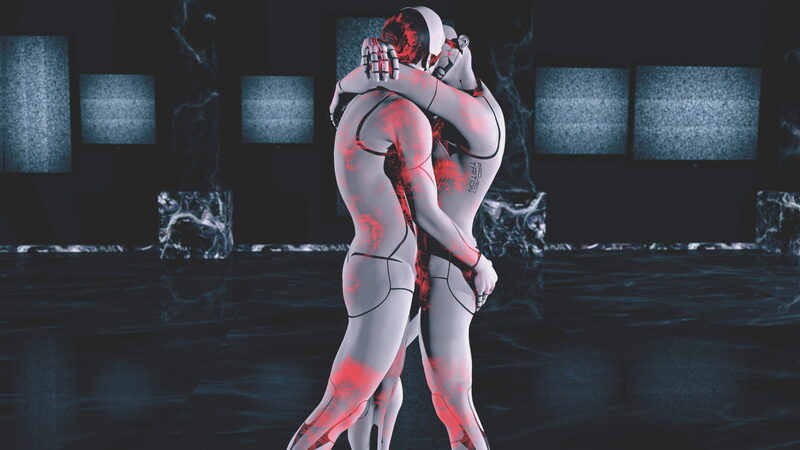
The premise is misleadingly simple. Six cyborgs, paired off into three couples, enter the “Human Museum,” a sterile, curated space designed to present humanity as an object of study. What they encounter are not people but representations: statues of intertwined bodies, anatomical diagrams, and instructional imagery outlining reproduction and physical intimacy. The film’s refusal to include dialogue is crucial here. Without words to guide interpretation, every reaction is conveyed through posture, hesitation, and subtle shifts in movement. Astonishment, revulsion, fear, and curiosity all flicker across faces that are not quite human, creating an uncanny “language” that feels half-decoded.
WETWARE leans into a CGI style that recalls late-2000s video game cutscenes. The textures are slightly stiff, the movements just a touch mechanical, and the environments feel intentionally artificial. Rather than undermining the film, that aesthetic choice strengthens its central dissertation. These figures aren’t meant to pass as human; they’re intended to approximate humanity while remaining visibly something else. The result is a persistent sense of distance, as though you’re watching a simulation learn how to simulate something else.
One of the most effective choices comes midway through the short, when a red door appears, and the cyborgs enter a theater. Seated together, they watch other cyborgs performing the sexual acts they’ve just observed in the museum. It’s a blunt but smart metaphor; before participation comes observation, before embodiment comes instruction. Sex, in this framing, isn’t spontaneous or emotional. It’s archival, instructional, and repeatable. The cyborgs don’t discover desire; they’re taught how desire is supposed to look.
When the couples attempt to replicate what they’ve seen, the film resists eroticism. There are no explicit details, no sensationalized movements. The cyborgs don’t even possess visible genitals. What follows is closer to an imitation of closeness; kissing, touching, holding one another in ways that resemble intimacy without fully achieving it. This restraint is where WETWARE finds its emotional center. The absence of completion becomes the point. These machines can perform the motions flawlessly, but something essential never quite clicks.
That tension feeds directly into the film’s core question: can machines ever feel what their bodies mimic? WETWARE doesn’t attempt to answer that outright, and that’s to its credit. Instead, it stages the question through repetition and escalation. The final moments, showing a much larger gathering of cyborgs waiting to enter the Human Museum, reframes the entire experience as a process rather than a revelation. This isn’t a one-time awakening; it’s an ongoing program. Desire becomes a curriculum.
What’s particularly effective is how the museum setting implicates the viewer. Museums are spaces where humanity categorizes itself, deciding what’s worth preserving and how it should be contextualized. By placing sex and intimacy behind glass, WETWARE highlights how often rules, expectations, and performative scripts already mediate those experiences. The cyborgs may be artificial, but the way they learn mirrors how humans usually learn about sex: through images, demonstrations, and cultural repetition rather than instinct alone.
There are limitations, and they’re worth acknowledging. The short’s emotional distance is intentional, but it also means some viewers may find it cold or inaccessible. The characters are symbols first and individuals second, which can limit emotional investment. At times, the visual language leans so heavily on the concept that it risks feeling academic, more like an art installation. For some, that will be a strength; for others, it may create a sense of detachment.
Within its self-imposed boundaries, WETWARE is remarkably disciplined. It never wastes time explaining itself, never pads its runtime with unnecessary imagery, and never reaches for provocation. Instead, it trusts the audience to sit with ambiguity. The short doesn’t ask whether machines can feel desire so much as it asks whether humans fully understand where their own desire comes from. If intimacy can be taught, cataloged, and replicated, then the line between feeling and practiced behavior becomes uncomfortably thin.
WETWARE works best as a spark rather than a complete statement. It’s a piece that invites discussion rather than closure, and it feels at home in environments where ideas are meant to be debated as much as experienced. By the time the final image fades, the film leaves you with an unsettling realization: the machines waiting in line aren’t just learning about humanity. They’re reflecting it, stripped of romance and reduced to procedure.
I’m always happy to hear from my readers; please say hi or send me any questions!
[photo courtesy of PINKLABEL.TV]
DISCLAIMER:
At Red Light Rated, we are committed to transparency and honest reviews. Occasionally, we receive free access to certain websites to provide in-depth evaluations, but this does not influence our opinions. We always prioritize fair, unbiased, and insightful assessments to help you make informed decisions. Additionally, some links in our reviews are affiliate links, meaning we may earn a small commission if you sign up through them at no extra cost.