 0
 0
REVIEW
Liz: “Momma’s Little Girl”
Genre: Fantasy, Vintage, Sexploitation
Year Released: 1973, 2023 DVD
Runtime: 1h 1m
Director(s): Josephine Milne
Cast: Antoinette Maynard, James Mathers, Thad Watson, Penny King
Where to Watch: available now; order your copy here: www.impulse-pictures.com
RAVING REVIEW: Hollywood has always been good at selling dreams, but it hasn't always been particularly interested in what happens to the people who get there believing those dreams will come true. LIZ: "MOMMA'S LITTLE GIRL" takes that story and strips away the glamour, then keeps stripping. There's no sweeping romance, no magical breakthrough, and certainly no promise that a little perseverance will lead to fame and fortune. Instead, we follow a young woman trying to survive in a city that cares more about what she can give them than what she actually wants from life. The film shows us, in unblinking reality, exactly what "providing" entails. It's a dark, often uncomfortable piece of Golden Age adult cinema. What makes it so interesting is how effectively it combines bodies pressed into mattresses, mouths, thighs, the whole unglamorous mess of it all, with a surprisingly bleak understanding of financial desperation.
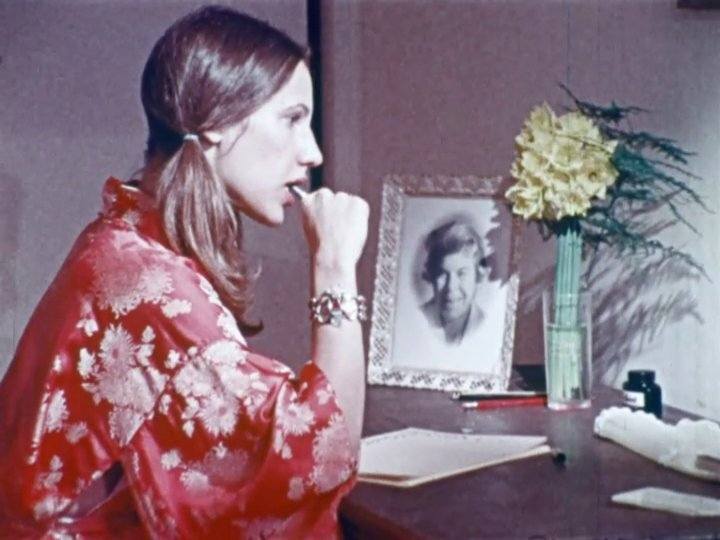
Antoinette Maynard, credited here as Lilly Foster, plays Liz, a young woman living in Hollywood who has turned to prostitution to support herself. She also sends money home to her mother, carefully maintaining the impression that everything is going perfectly. The letters she writes become the film's central storytelling device, letting us hear the comparatively innocent version of events she's willing to share while watching the far less pleasant reality unfold, usually with her legs in the air.
It's a simple story, but an effective one. Liz's mother doesn't need to appear on screen for their relationship to matter. Her presence exists through the letters, through Liz's determination to send money home, and through the distance between the life she's describing and the life she's living. That difference gives the film a sadness that might otherwise be missing from what could've been a straightforward collection of sexual encounters, filmed with a frankness that leaves little to the imagination.
I appreciate that director Anthony Spinelli doesn't try to disguise the situation with sentimentality. Liz isn't shown as someone enjoying a glamorous alternative lifestyle. She's working, she's trying to make money, and she's finding herself in situations where other people hold more power than she does. That doesn't mean she's without agency. The film makes it hard to overlook the financial circumstances shaping her decisions, and it rarely lets a scene end before we've seen their cost written across her body.
Maynard is essential to making that work. She has a wonderfully expressive face, a natural screen presence, and a confidence that suits the sex scenes without making Liz feel disconnected from the story. She's attractive, charismatic, and comfortable carrying a film built almost entirely around her character's encounters, and comfortable in the most literal sense, unbothered by long takes that linger on her, on the softness of her stomach, on the dark triangle of hair between her legs that marks this so clearly as a production of its era.
One quality I particularly appreciate is how she adjusts her demeanor depending on the person she's dealing with. Liz isn't necessarily the same woman in every situation, and that makes sense. She's performing, responding to different personalities, and attempting to navigate circumstances that aren't always in her control. The differences between her interactions, the way she'll arch and coo for one customer and go quiet and compliant for another, add variety to a film that relies on a fairly repetitive structure.
The opening establishes the tone immediately. James Mathers, playing the character credited as Daddy, adopts an aggressively demeaning approach that turns the interaction into an exercise in humiliation and control. He has her stripped and positioned like a dog before the scene is a minute old, and then he simply talks over her. His dialogue is relentless, repeatedly reducing Liz to an animal-like role while issuing instructions. Spread them, hold still, don't move, treating her compliance as part of the arrangement. The camera stays low and close, giving us the same view he has, and the effect is like watching a transaction being processed.
It establishes the film's atmosphere effectively. Whatever expectations someone might bring to an adult feature set in Hollywood, this opening offers little romance or glamour. Instead, it emphasizes the imbalance between someone paying for an experience and someone whose circumstances require her to participate, and the sequence is long enough, and explicit enough, that the imbalance stops being subtext and becomes something you can feel in your own back.
Maynard handles the material with commitment. The performance requires her to move between obedience, responsiveness, and moments of enthusiasm, genuine little jolts of pleasure that complicate the humiliation without ever canceling it, creating an interesting distinction between what Liz presents to the customer and what we understand about her broader situation. The film doesn't spend much time explaining that distinction, but the surrounding narrative makes it difficult to ignore.
After spending so much time treating Liz as less than an equal, he adopts a strangely sentimental tone, calling her a good girl, stroking her hair, and murmuring endearments mid-thrust, without ever really abandoning the role he's established. It's a revealing contradiction, suggesting that his idea of affection is inseparable from the control he enjoys exercising.
From there, the story moves into a pretty unique setting, an automatic car wash. It becomes an unexpectedly effective backdrop for another encounter. Liz finds herself in the backseat with her boss. The car wash creates an unusual mix of privacy and exposure, and the film draws real tension from the fact that anyone walking past the fogged glass could see exactly what's happening. The car wash is a strong example of how a modest production can turn a location into something so interesting. The water moving across the windows, the shifting light, the confined space, and the awkward interactions of the two in the backseat. The performers move even though they're restricted by the vehicle, and the claustrophobia makes the physicality read more like effort than choreography.
The scene showcases one of the film's strongest creative moments. Rather than relying exclusively on explicitness, Spinelli lets the environment shape the encounter. The visual contrast between the carwash and the activity inside gives the sequence an identity. It's a small decision, but one that helps distinguish the film from other features of the period.
The encounter involving Tommy, played by Thad Watson, is arguably the best expression of the business behind Liz's circumstances. Their conversation begins with what he describes as an examination rather than an interview, immediately making the power relationship explicit, and then literal, as he puts her through her paces on a bed while delivering a running appraisal of her technique as though it's his job.
The most revealing detail is his claim that he has thirty-eight women working for him. Whether the number is intended to impress Liz or intimidate her, it tells us how he views the business. She's potentially another addition to an operation he discusses with the detached confidence of someone managing inventory, and the fact that he's still inside her. Their conversation about money matters just as much. Liz explains what she's used to earning, and he suggests the women working for him can earn considerably more. That possibility becomes part of the pressure on her, with the promise of better compensation offered alongside an expectation that she demonstrate her suitability, which she does, thoroughly, and on his terms. The idea of a job interview becomes a sexual test, and the distinction between professional opportunity and personal submission is effectively erased.
Money, clients, expectations, and arrangements remain part of the conversation, mumbled into skin and picked up again between positions. The result is a sequence that communicates something about Liz's circumstances rather than existing exclusively as another adult interlude. That's all part of the film's identity. LIZ: "MOMMA'S LITTLE GIRL" doesn't seem interested in becoming glamorous. Its locations look ordinary, its presentation is relatively straightforward, and much of it feels deliberately removed from the fantasy environments that dominate more elaborate adult productions.
The restaurant encounter introduces another change of setting and a different kind of urgency. Liz's narration explains that she's met someone associated with a restaurant, someone she can describe to her mother in relatively respectable terms. The reality is considerably more complicated, with the encounter unfolding across a table before the establishment opens and the possibility of someone walking in becoming a source of tension.
The dialogue is wonderfully frantic at times. The concern about being seen gives the sequence an almost comic quality, as though the participants are attempting to complete an ill-advised arrangement before business resumes, half dressed, half listening for the door. Again, it's the environment that makes the movie memorable. The restaurant isn't just an interchangeable location. Its temporary closure provides the premise, and the urgency around the possibility of interruption helps distinguish the encounter from the film's other situations.
The contrast between Liz's letters and what we're watching is particularly effective here. She can truthfully describe meeting someone who owns a restaurant and being invited there, but the context changes everything. Her words aren't fabrications. They're carefully constructed fragments of the truth, selected to maintain the image she wants her mother to believe. That's probably the most interesting aspect of the screenplay. The film understands that deception doesn't always require an elaborate invented story.
The later scenes involving Belita, played by Penny King, further complicate Liz's experiences. It introduces a more intimate, psychologically charged situation, slower, softer, and more attentive than anything the men have offered, one that differs from the straightforward relationships established earlier. The film's treatment of vulnerability matters here. The dialogue contains expressions of affection and need, but those words shouldn't automatically be taken as evidence of a romantic relationship. In a story where sexuality and power have been so closely connected, declarations of intimacy can carry multiple meanings.
I appreciate that the film doesn't suddenly transform into a conventional love story. Its underlying discomfort remains part of the experience, even when the tone becomes more personal. The relationships may be something else, but Liz's circumstances haven't improved simply because someone expresses affection. That refusal to offer an easy romantic escape fits the film's presentation. It doesn't promise that one meaningful encounter can resolve the financial and emotional difficulties established earlier.
I wouldn't claim that the screenplay provides a deeply developed psychological portrait. It doesn't. Substantial gaps remain in what we learn about her background, motivations, and personal relationships. But the basic premise gives Maynard enough to establish a character who matters, and her performance helps keep the film from becoming one-dimensional.
The roughness feels consistent with the world being depicted, and the lack of polish gives the film a certain credibility as an artifact of early 70s adult production. It belongs to a period when filmmakers were still experimenting with how much story an explicit feature needed, what audiences wanted, and how sexuality could be integrated into something resembling dramatic filmmaking.
Spinelli doesn't resolve those competing ambitions, but he creates an interesting intersection between adult entertainment and low-budget social drama. The result is neither a deep character study nor a completely anonymous collection of encounters. It occupies a space between the two, and that tension is part of what makes it memorable.
For its limitations, LIZ: "MOMMA'S LITTLE GIRL" delivers an unmistakable piece of Golden Age porn cinema, anchored by a charismatic performance and a premise that gives its explicit material more context than it strictly needs. The encounters offer variety, the locations provide some genuinely memorable situations, and the contrast between Liz's letters and her actual circumstances gives the film an emotional undertone that occasionally catches you off guard.
It's not a romantic Hollywood fantasy. It's about someone doing what she believes she needs to do, presenting a carefully edited version of her life to the people she loves, and enduring circumstances that don't always offer much dignity.
The film may have been produced as adult entertainment, though its most memorable aspect is deeply human. The distance between the lives we lead and the lives we want the people back home to believe we're living. Antoinette Maynard gives that idea an engaging central presence, and even when the filmmaking stumbles, the personality and atmosphere make the experience worthwhile. Hollywood might sell the dream, but somebody still has to pay the rent. LIZ: "MOMMA'S LITTLE GIRL" knows exactly how uncomfortable that can become.
I’m always happy to hear from my readers; please say hi or send me any questions!
[photo courtesy of IMPULSE PICTURES, SYNAPSE FILMS]
DISCLAIMER:
At Red Light Rated, we are committed to transparency and honest reviews. Occasionally, we receive free access to certain websites to provide in-depth evaluations, but this does not influence our opinions. We always prioritize fair, unbiased, and insightful assessments to help you make informed decisions. Additionally, some links in our reviews are affiliate links, meaning we may earn a small commission if you sign up through them at no extra cost.